What Causes Lower Right Back Pain in Males, and When Should You Seek Treatment?
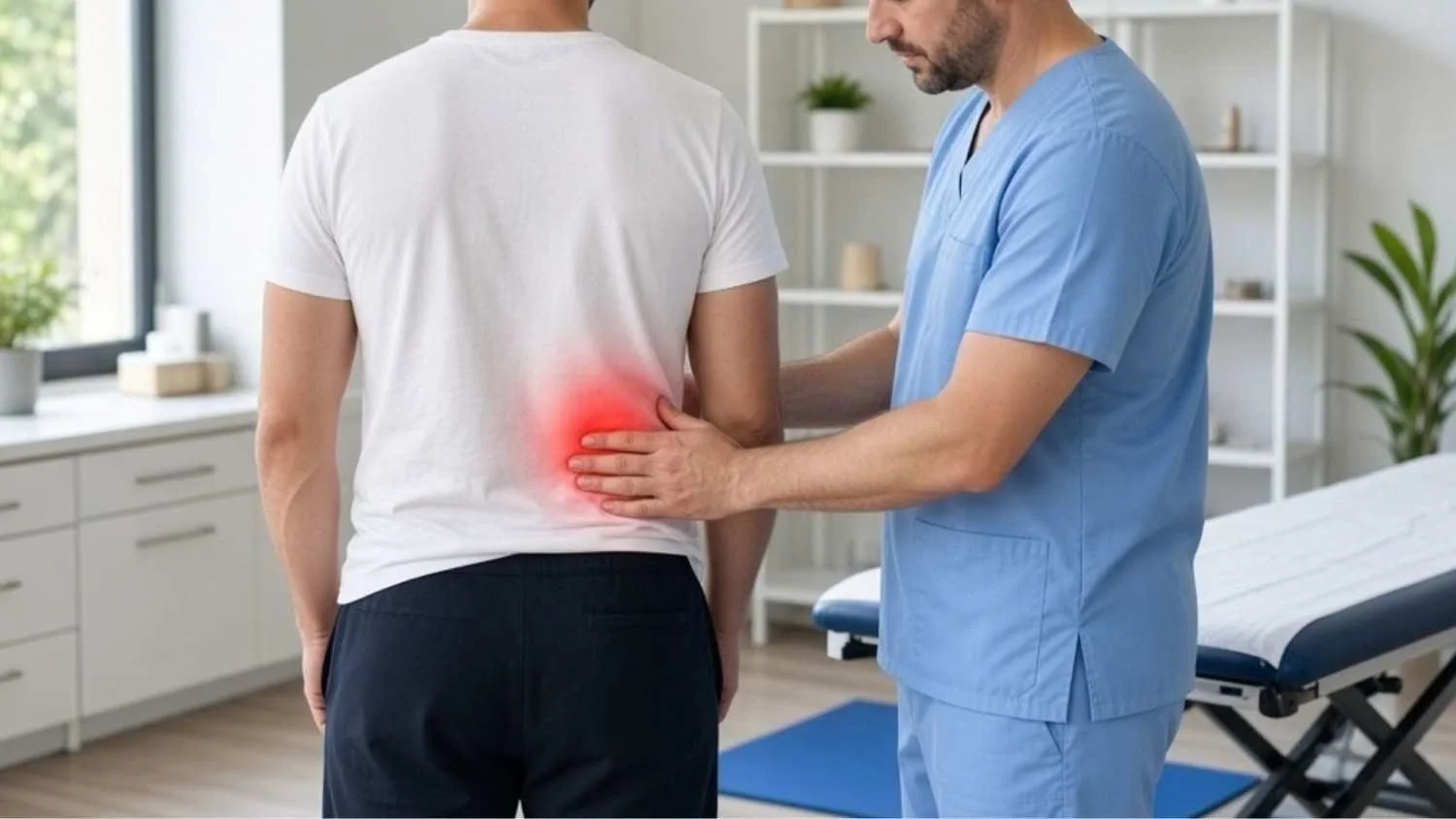
Lower right back pain in men is rarely random. In most cases, it reflects how the body is loading, moving, and compensating, whether the source is a strained muscle, an irritated joint, or a compressed nerve. In a smaller number of cases, it signals a problem with an organ such as the kidney or prostate, and that needs medical attention first.
Knowing the difference matters. Whether you are searching for lower right back pain male causes, trying to understand why back pain on the right side keeps returning, or simply asking what causes lower back pain in men, this guide explains the most common causes, what the medical terms mean, which warning signs call for a doctor, and what may help when the cause is muscular or structural.
How Common Is Back Pain in Men, According to CDC Data
Back pain in men is widespread. In the CDC's National Health Interview Survey, 28.0% of men reported lower back pain in the previous three months in 2018. In 2019, 37.2% of men reported back pain of any kind over the same period. Women reported it more often (31.6% and 40.6%), but the figures for men are substantial.

Prevalence also rises with age. Among all U.S. adults in 2019:
| Age group | Adults with back pain |
|---|---|
| 18 to 29 | 28.4% |
| 30 to 44 | 35.2% |
| 45 to 64 | 44.3% |
| 65 and over | 45.6% |
Source: CDC, National Center for Health Statistics, National Health Interview Survey (2018 QuickStats and NCHS Data Brief No. 415, 2019). The survey did not separate right-sided pain, and the age figures cover men and women combined.
What Causes Lower Back Pain in Men and Why the Right Side Is Often Affected
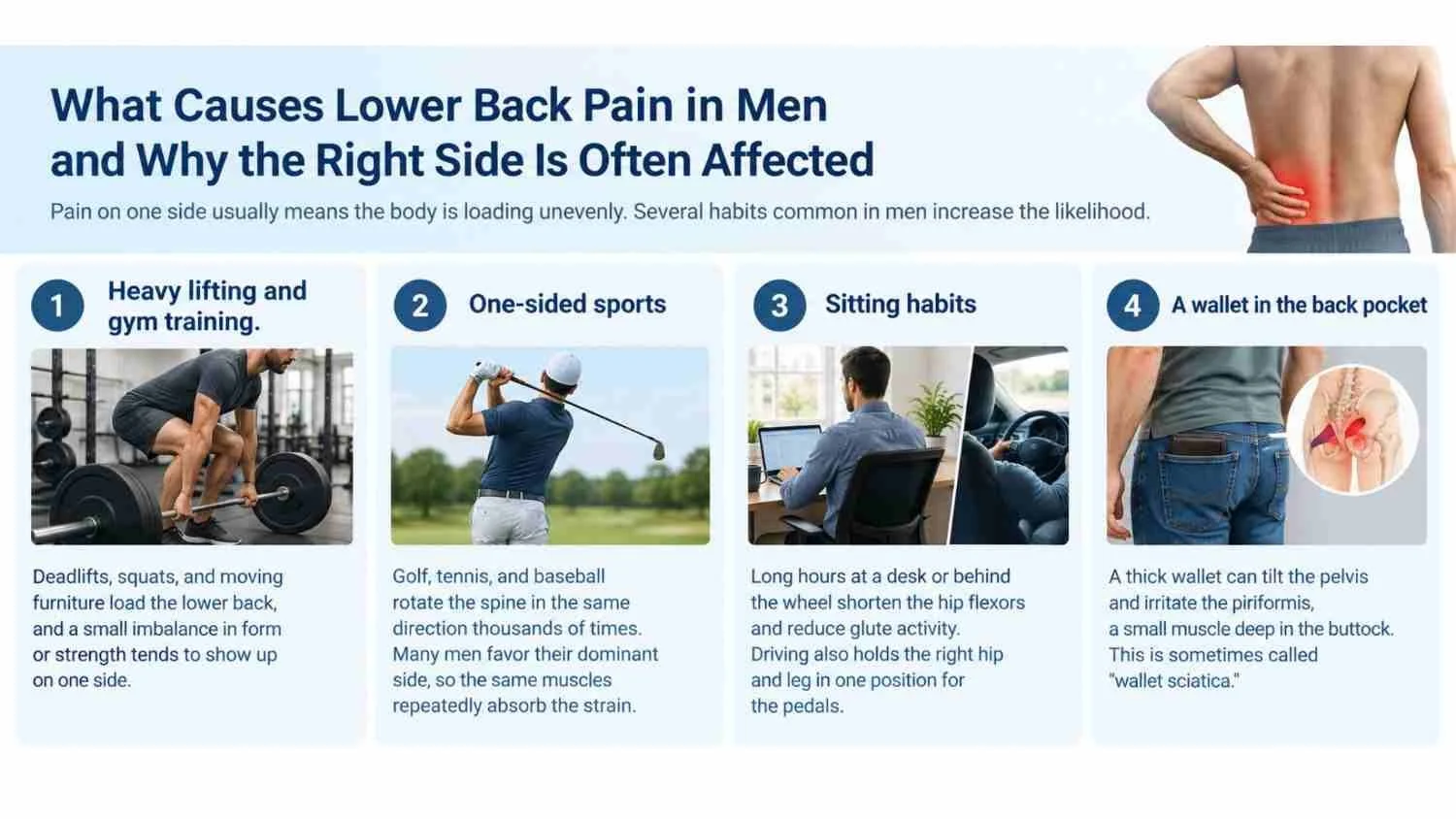
Heavy Lifting and Gym Training
Exercises such as deadlifts and squats can place significant demands on the muscles and structures that support the spine, especially when performed with heavy loads. Poor technique, fatigue, or rapidly increasing the weight can increase the risk of lower-back strain and pain.
One-Sided Sports
Sports such as golf, tennis, and baseball involve repeated twisting and movement toward a preferred side, which can place repeated stress on the lower-back muscles and joints. Overtraining, inadequate recovery, or poor movement mechanics may contribute to pain that is more noticeable on one side.
Prolonged Sitting
Spending long periods sitting, especially with poor posture or limited movement, can increase discomfort and stiffness in the lower back. Taking regular movement breaks and maintaining a comfortable, supported sitting position can help reduce strain.
Wallet in the Back Pocket
Sitting for long periods with a thick wallet in the back pocket can tilt the pelvis and create an uneven sitting position, potentially contributing to discomfort in the lower back or buttock area. Removing the wallet before sitting may help maintain a more balanced posture and reduce localized pressure.
The causes of lower back pain in men rarely act alone. Over months and years, they can leave the right side of the lower back doing more than its share.
Types of Lower Right Back Pain in Men and What Each Term Means
Doctors describe back pain as acute when it began recently, usually within the past few weeks, and chronic when it has lasted longer than about three months. The causes of chronic lower back pain in men tend to involve joint wear, disc changes, or long-standing movement imbalances, while acute episodes are more often strains.
Many men also describe this region as the waist, so waist pain in men is very often lower back pain. Lower right back pain in male patients most often falls into one of the types below.
Muscle Strain
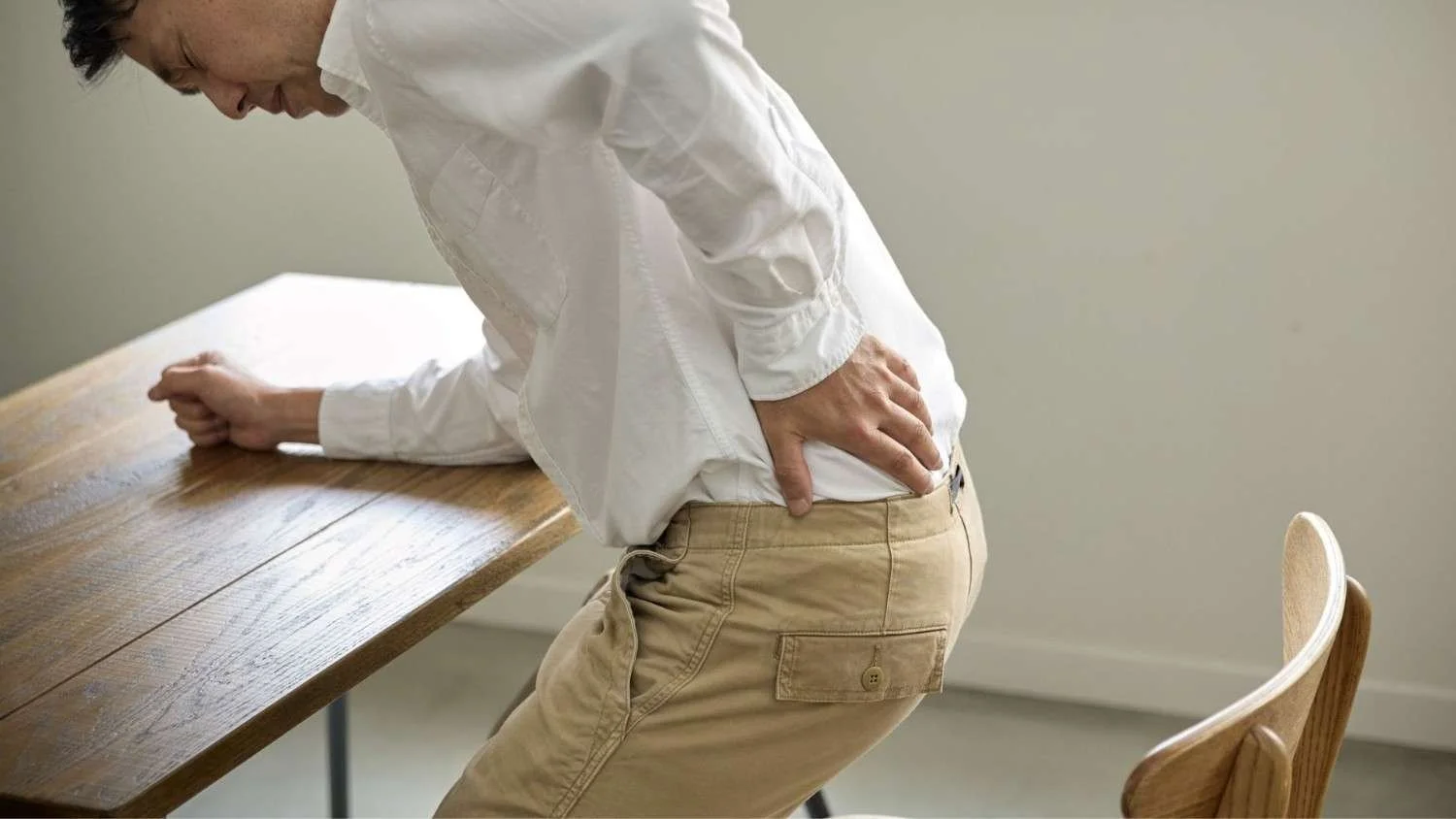
A strain is a stretch or small tear in a muscle. In the lower back, the most common sites are the quadratus lumborum (QL), a deep muscle linking the lowest rib, the spine, and the top of the pelvis, and the erector spinae, the long muscles running alongside the spine.
A strain typically feels like a deep backache in men after a hard weekend, or a sharp catch on one side that worsens when you bend, twist, or reach.
Sacroiliac (SI) Joint Pain
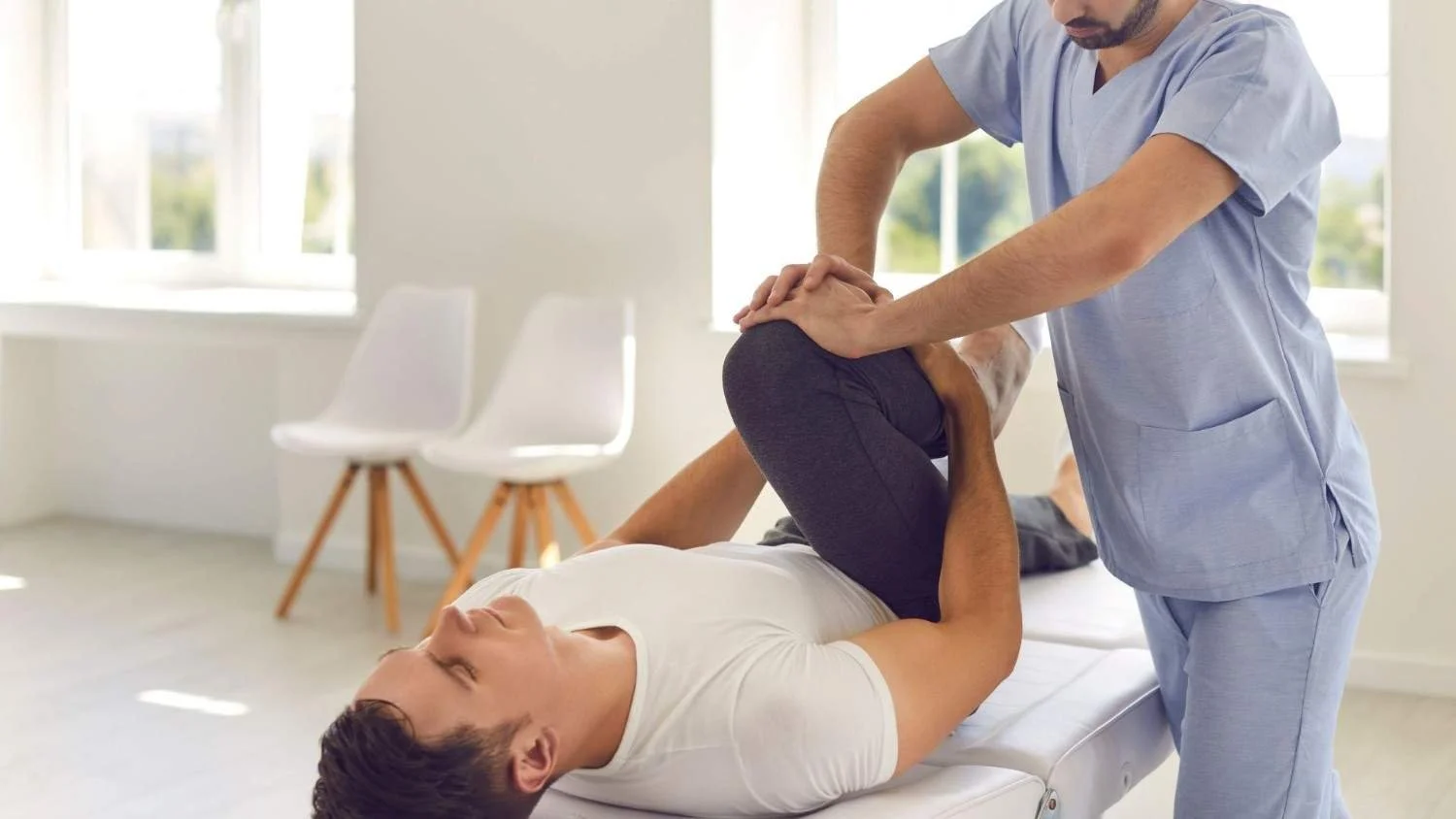
The sacroiliac joint is where the sacrum, the triangular bone at the base of the spine, meets the ilium, the large bone of the pelvis. There is one on each side.
When the right joint is irritated, pain sits low, often near the dimple above the buttock, and may extend into the buttock or groin. Standing up from a chair or turning over in bed commonly triggers it.
Disc Problems
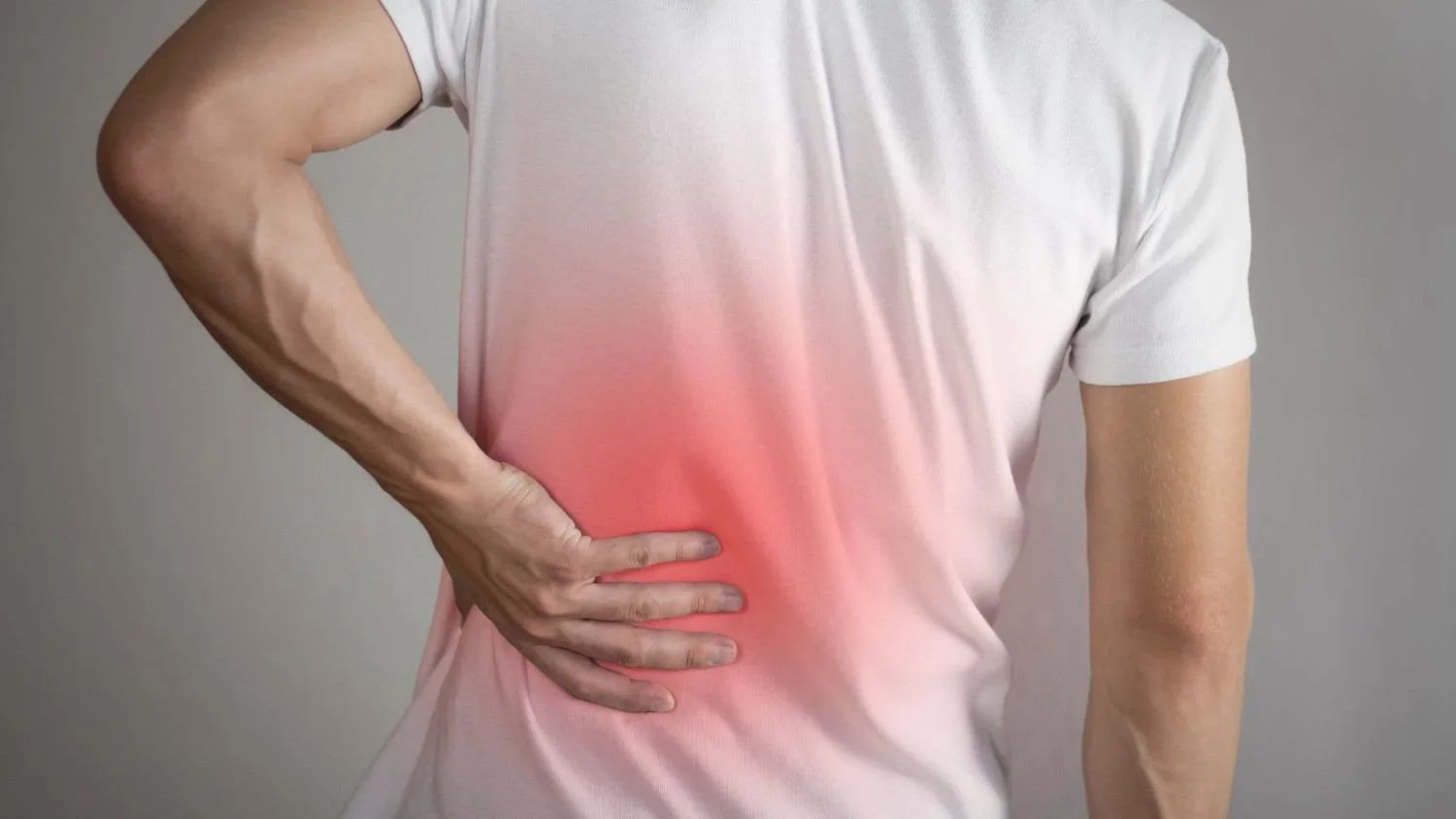
Between each pair of vertebrae, the individual bones of the spine, sits a disc, a cushion that absorbs shock. A bulging disc extends beyond its normal edge. A herniated disc has allowed some of its inner material to escape.
Either can press on a nerve root, the point where a nerve leaves the spinal cord, and cause one-sided pain.
Sciatica
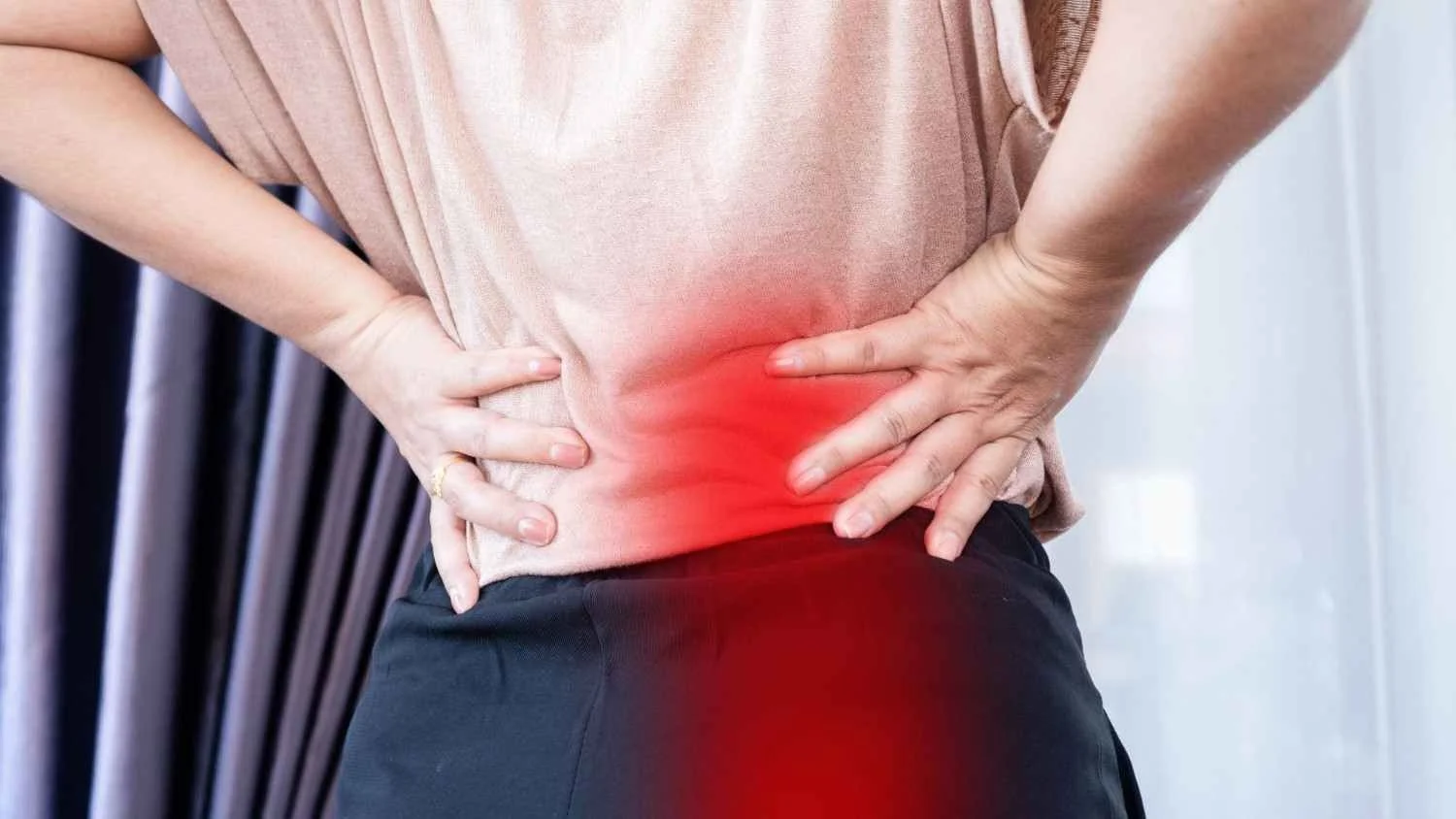
Sciatica is not a diagnosis in itself. It describes pain that follows the sciatic nerve, which runs from the lower back through the buttock and down the back of the leg.
A disc problem, a narrowed spinal canal (spinal stenosis), or a tight piriformis can irritate it. On the right side, it may present as back pain that continues down the right leg.
When Lower Right Back Pain in Men Is Not a Muscle Problem
Several organs sit close enough to the lower right back that their pain is felt there. Doctors call this referred pain, meaning pain felt away from its source.
These lower back pain causes in men are less common than muscle or joint problems, but they are the ones that must not be missed.
Lower Back Pain and Groin Pain in Men
When lower back pain and groin pain in a male occur together, the source is sometimes the urinary or reproductive system rather than the spine.
● Kidney stones are hard mineral deposits that form in the kidney. They can cause severe, wave-like pain in the flank, the side of the body between the ribs and the hip, that may spread to the groin.
● Prostatitis is inflammation or infection of the prostate. It can cause lower back pain and pelvic pain in men, often with frequent or painful urination.
● Inguinal hernia is a bulge where tissue pushes through a weak spot in the lower abdominal wall. It may cause groin discomfort and a deep ache that appears when you lift or strain.
● Testicular torsion occurs when a testicle twists and cuts off its own blood supply. It mostly affects teens and younger men, causing sudden severe pain in the testicle or groin, sometimes with lower abdominal or back pain and nausea. It is an emergency because hours matter.
Not every case of groin and back pain in men is an organ problem. A right SI joint or hip problem can also refer pain toward the groin, which is why a proper examination matters.
How to Tell Kidney Pain From Muscle Pain in the Lower Right Back
Location and movement are the two most useful clues when sorting out right-side lower back pain in men.
| Muscle or joint pain | Kidney-related pain | |
|---|---|---|
| Where | Low, around the beltline or hip | Higher, under the ribs toward the side |
| Movement | Changes when you bend, twist, or shift position | Stays about the same in any position |
| Feels like | Aches, tightness, sharp catch | Deep, constant, or wave-like |
| Other symptoms | Local tenderness and stiffness | Fever, nausea, urinary changes |
This is a general guide, not a diagnosis. If you cannot tell the difference, get it checked.
How Lower Back Pain in Men Is Diagnosed
A thorough evaluation begins with your history. Where is the pain, what makes it worse, and what were you doing when it started?
A physical exam follows, assessing how you move and checking strength, reflexes, and sensation. Depending on the findings, a clinician may order urine or blood tests, or imaging such as an X-ray, ultrasound, CT, or MRI.
Many ordinary muscle and joint problems do not require imaging.
How to Relieve and Prevent Lower Right Back Pain in Men at Home
When there are no warning signs, simple measures usually help. Stay moving, since short walks are generally better than extended bed rest. Heat can ease tight muscles, and cold may help in the first day or two after a strain.
Back pain for men often responds best to a few consistent habits. To reduce the chance of recurrence:
● Break up long sitting with a short walk every 30 to 45 minutes.
● Remove the wallet from your back pocket, especially on long drives.
● Warm up before sport and lifting, and increase weight gradually.
● Lift with your legs, keep the load close, and avoid twisting.
● Stretch the hip flexors and glutes, and strengthen the core over time.
● Alternate sides when you can, such as carrying a bag on the opposite shoulder.
If any of these make the pain worse, or you notice numbness or weakness, stop and get evaluated.
How to Get Help for Lower Right Back Pain in Men in Harrison, NY
Once other causes of male lower right back pain have been ruled out, the central question is why the right side is the one taking the load.
Treating only the sore spot rarely holds. Identifying the pattern behind it, whether that is a restricted hip, a weak glute, or a lifting habit, is what produces lasting relief.
That is the approach at Bomi Massage. Bomi Bilimoria is a New York State licensed massage therapist and a former mechanical engineer, certified in the Hendrickson Method Orthopedic Massage, the first such certification in the NYC area. He treats root causes, not just symptoms.
A first session begins with a thorough intake and assessment, followed by focused, technique-driven work that may include orthopedic massage, PNF stretching, or sports massage, depending on what your body needs.
Frequently Asked Questions
Is lower right back pain in men a sign of kidney problems?
Sometimes, but it's more often muscular or joint-related. Kidney pain tends to sit higher under the ribs and usually comes with fever, urinary changes, or nausea. See a doctor if you notice those signs.
Can a pinched nerve cause lower right back pain?
Yes. An irritated nerve root in the lower spine can cause one-sided back pain, often with pain, tingling, or numbness down the leg.
Why does my lower right back hurt only on one side?
One-sided pain often reflects an imbalance: a dominant side in sport or work, a tight hip, or an irritated SI joint or QL muscle.
Can massage help lower right back pain in men?
Massage may help relieve muscle tension and improve movement when the cause is muscular or structural. It isn't a replacement for medical care when other causes are suspected.
How do I know if my back pain is serious?
Fever, blood in the urine, loss of bladder or bowel control, leg weakness, groin numbness, or pain after trauma all warrant prompt medical attention.
Why does my lower right back hurt when I lift or sit for long periods?
Lower right back pain can worsen with lifting when the muscles or joints on that side are strained by heavy loads, twisting, poor lifting technique, or carrying weight unevenly. Prolonged sitting can also contribute to discomfort by keeping the lower back and hips in one position, while driving or sitting on a thick wallet in the back pocket may create additional pressure or an uneven sitting position that aggravates the lower back or buttock area.